
 About us
 Services
 Projects
 Blogs
Blogs


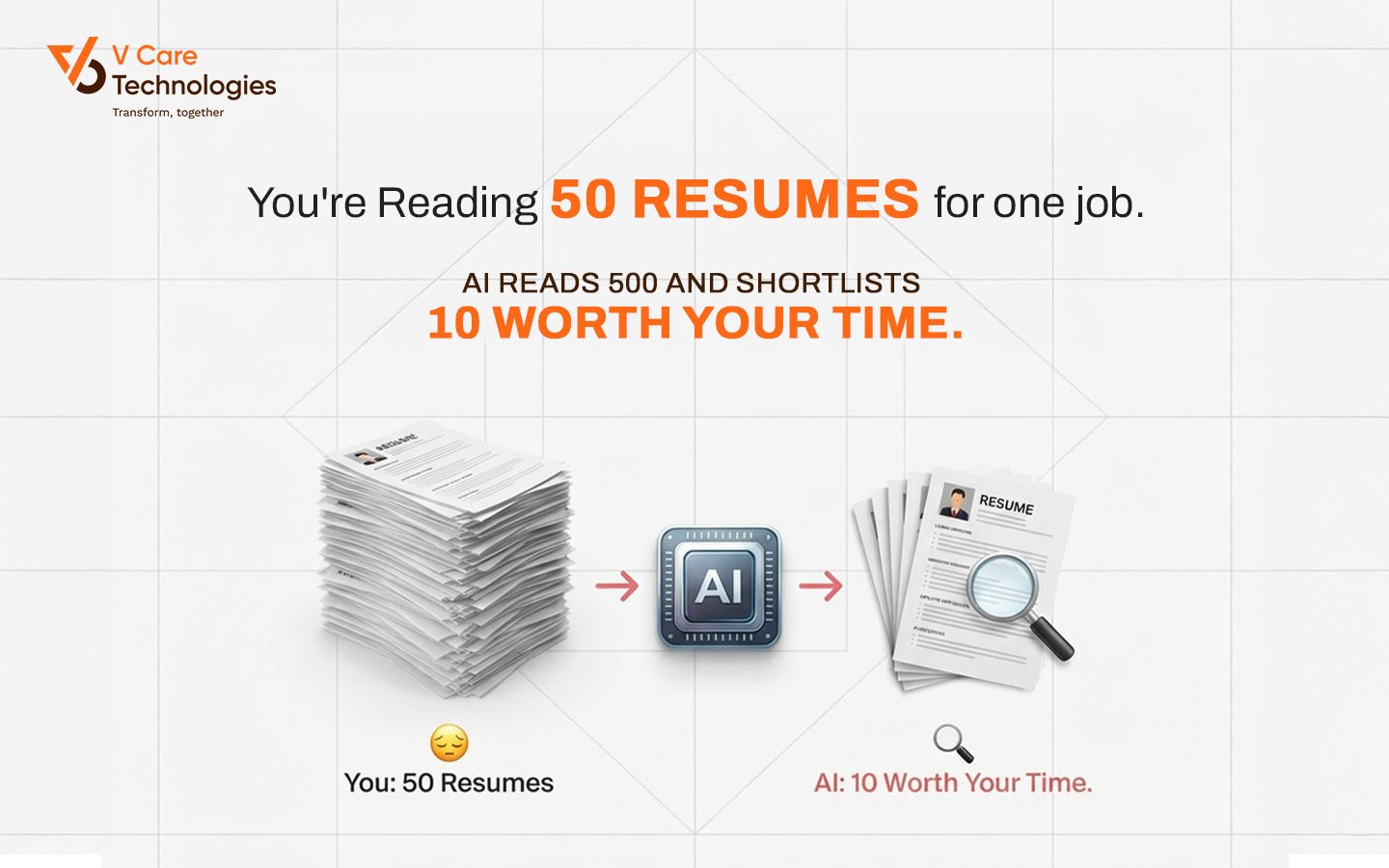
The Resume Pile That Never Shrinks
You posted a job opening for a mid-level accountant. Within
a week, 200 applications arrived.
Your HR person starts reading. First resume: not qualified.
Second: overqualified. Third: wrong location. Fourth: relevant experience but
job-hopping pattern. Fifth: interesting, set aside.
At 5-7 minutes per resume for proper evaluation, those 200
applications represent 15-20 hours of reading. That's three full workdays just
to create a shortlist.
And this is for one position. What happens when you're
hiring for multiple roles simultaneously?
The resume pile becomes a bottleneck that delays hiring,
exhausts HR staff, and sometimes results in good candidates being lost because
they accepted offers elsewhere while you were still screening.
What AI Actually Does
With Resumes
AI resume screening isn't magic. It's pattern matching at
scale.
You define what you're looking for: qualifications,
experience, keywords, locations, salary expectations. AI scans every resume
against these criteria and scores each one.
Keyword extraction: Does the resume contain relevant skills,
technologies, certifications?
Experience matching: Does the candidate have the right years
of experience in relevant roles?
Education verification: Does the qualification match
requirements?
Pattern recognition: Employment gaps, job-hopping, career
progression trajectory.
Red flag identification: Inconsistencies, mismatched dates,
implausible claims.
The output isn't a hiring decision. It's a prioritized list.
The top 20 resumes that best match your criteria, ready for human review.
The Time Calculation
Manual screening of 200 resumes:
- Time:
15-20 hours
- Quality:
Diminishing attention after first 50
- Risk:
Good candidates missed due to fatigue
AI screening of 200 resumes:
- Time:
5-10 minutes
- Quality:
Consistent criteria across all 200
- Output:
Top 20 ranked candidates for human review
Human review of 20 shortlisted resumes:
- Time:
2-3 hours
- Quality:
Fresh attention, focused evaluation
- Confidence:
AI filtered obvious mismatches
Total time saved: 12-17 hours per hiring cycle.
For a company doing 10 hires per year, that's 120-170 hours
annually - essentially a full month of HR time recovered.
The Manufacturing Company Case
A manufacturing company hiring for supervisory positions
received 300 applications. HR team of 2 was already stretched with regular
work.
Before AI: Two weeks to screen and shortlist. First-round
interviews scheduled for week 3. Top candidate had already accepted another
offer by then.
After implementing AI screening: Initial shortlist ready in
2 hours. HR reviewed top 30 candidates by day 2. Interview calls began day 3.
Top candidates were engaged before other companies completed screening.
Time to hire reduced from 45 days to 18 days. Quality of
shortlist improved because criteria were consistent. HR had time for actual
conversations instead of paperwork.
What AI Can't (And Shouldn't) Decide
AI screening is a filter, not a decision maker.
Culture fit remains human judgment. Does this person align
with team dynamics? Will they thrive in your environment?
Potential assessment needs human insight. Some candidates
have unconventional backgrounds but high potential. AI might filter them out
based on criteria; humans can spot diamonds in rough.
Final selection requires context. Compensation negotiation,
team balance, growth trajectory considerations - these need human
decision-makers.
Bias mitigation requires oversight. AI can inadvertently
encode biases present in training data. Human review ensures diversity and
fairness.
The ideal workflow: AI handles volume (screening hundreds).
Humans handle judgment (evaluating tens).
Implementation Approaches
Built-in ATS features: Many Applicant Tracking Systems now
include AI screening. Check if your existing system offers this.
Standalone AI screening tools: Services specifically for
resume analysis that integrate with your hiring workflow.
Custom implementation: For high-volume hiring, custom AI
trained on your specific criteria and historical successful hires.
Start simple. Even basic keyword matching and scoring saves
significant time compared to manual reading.
Key Takeaways
- Manual
resume screening of 200 applications takes 15-20 hours with diminishing
attention quality
- AI
screening reduces this to minutes, with consistent criteria application
across all resumes
- AI outputs
a prioritized shortlist for human review, not a hiring decision
- Time
to hire can reduce dramatically when screening bottleneck is removed
- Human
judgment remains essential for culture fit, potential assessment, and
final selection
The Bottom Line