



 About us
 Services
 Projects
 Blogs
Blogs


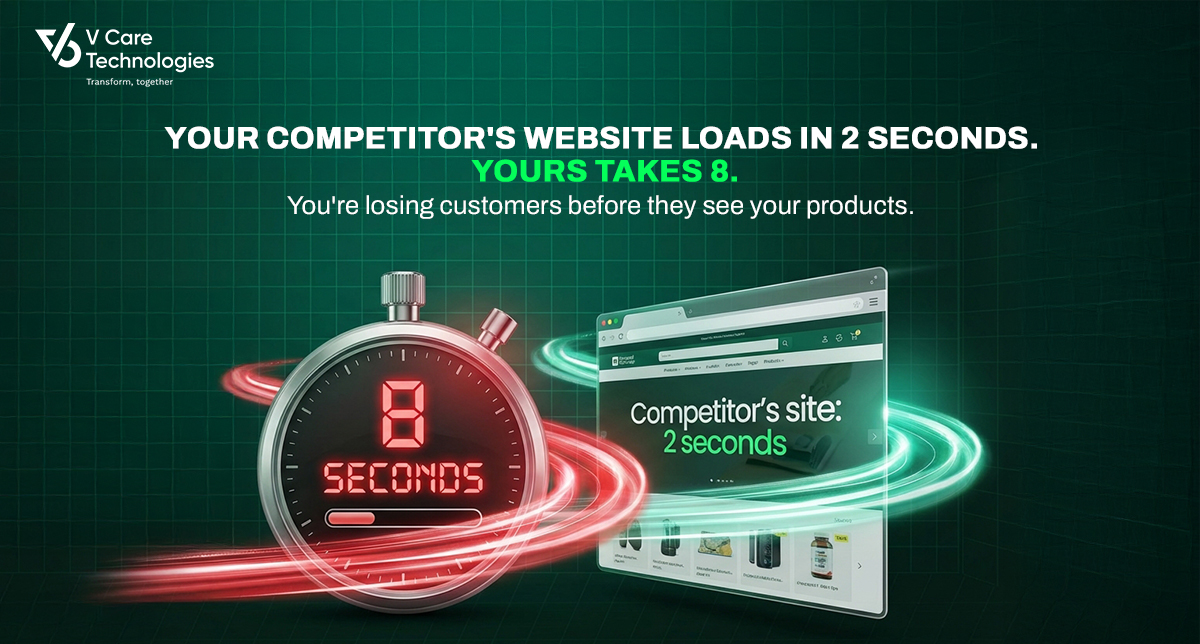
The 6-Second Problem That's Bleeding Your Business
Here's a scenario that plays out thousands of times daily
across Indian businesses.
A potential customer searches for your product on Google.
They click on your website. The screen stays blank. One second. Two seconds.
Three seconds. They glance at their phone impatiently. Five seconds. Six
seconds. They hit the back button and click on your competitor's link instead.
Your competitor's website loads in 2 seconds. They see the
products, make an inquiry, and become a customer. Your customer.
You never even knew they existed.
The Hard Numbers Behind Website Speed
Google's research reveals a brutal truth about user
patience. When page load time increases from 1 second to 3 seconds, the
probability of bounce increases by 32%. Push that to 5 seconds, and bounce
probability jumps to 90%.
Let's put this in perspective for your business.
If your website gets 1,000 visitors per month and takes 8
seconds to load, you're likely losing over 500 of them before they see a single
product. If even 2% of those lost visitors would have converted into paying
customers, that's 10 customers gone every month.
For a business with an average order value of ₹15,000,
that's ₹1,50,000 in lost revenue monthly. ₹18,00,000 annually. From a problem
you didn't even know you had.
Why Your Website Is Slow (The Usual Culprits)
Most business owners assume their website is "fast
enough" because it loads fine on their office Wi-Fi. But your customers
aren't on your office Wi-Fi. They're on mobile networks, often in areas with
patchy coverage.
The most common speed killers include unoptimized images.
That product catalog with 50 high-resolution photographs? Each image might be
2-3 MB. Multiply that across your product pages, and you're asking customers to
download 100+ MB just to browse.
Cheap hosting is another culprit. That ₹99/month hosting
plan seemed like a good deal until you realize your website shares server space
with 500 other websites, all competing for the same resources.
Bloated code from template websites adds invisible weight.
Every fancy animation, slider, and widget adds code that must be downloaded and
processed before your page appears.
One manufacturing company discovered their product catalog
page was 15 MB total. Customers on mobile networks couldn't even open it. The
page would timeout before loading. They had essentially made their catalog
invisible to mobile users.
How to Check Your Website Speed (Free, 2-Minute Test)
Open Google PageSpeed Insights in your browser. Type your
website URL. Click Analyze.
Within 60 seconds, you'll see a score from 0-100 for both
mobile and desktop performance. Below 50 is poor. 50-89 needs improvement. 90+
is good.
Pay special attention to the mobile score. In India, over
70% of your traffic is likely from mobile devices. If your desktop score is 85
but mobile is 35, you have a serious problem.
The tool also tells you exactly what's slowing you down:
which images need compression, which scripts are blocking the page, which
elements take longest to load.
The Fix: What Actually Works
Image optimization delivers the biggest impact with the
least effort. Tools like TinyPNG or ShortPixel can compress images by 60-80%
without visible quality loss. That 3 MB product photo becomes 400 KB. Your page
suddenly loads in half the time.
Hosting upgrade is often necessary for growing businesses.
Managed hosting solutions in the ₹2,000-5,000/month range offer dedicated
resources, automatic caching, and content delivery networks that serve your
site from locations closer to your customers.
Code cleanup requires a developer but pays long-term
dividends. Removing unused plugins, minifying CSS and JavaScript, and
implementing lazy loading for images can cut load times significantly.
Consider this investment perspective: if slow speed costs
you ₹18 lakhs annually in lost customers, spending ₹50,000 on speed
optimization delivers a 36x return.
Key Takeaways
- Every
second of load time beyond 3 seconds causes measurable customer loss
- Google
PageSpeed Insights gives you a free, instant diagnosis of your website's
performance
- Image
optimization alone can reduce page size by 60-80% and dramatically improve
speed
- The
cost of fixing speed issues is typically a fraction of the revenue lost to
slow performance
The Bottom Line
Your website's speed isn't a technical metric
that only developers should care about. It's a business metric that directly
impacts your revenue. Before you spend another rupee on advertising to bring
more visitors to your website, make sure you're not losing half of them in the
first 8 seconds. Test your speed today. The result might cost you some sleep
tonight, but ignoring it will cost you something far more valuable: customers
who never knew you existed.


